Regaining Contact With The Lost Depths Of Your Soul: The Shadow
- Ysabel Gilmore Farmer
- Dec 5, 2024
- 8 min read

Updated: Dec 8, 2024

In western psychology, the term “Shadow '' comes from studies of the human psyche made by Psychoanalytic Carl Jung, a student of Sigmund Freud. Sigmund Freud was making observations about the human psyche and its unconscious. Jung expanded on this idea of the unconscious and developed the term “shadow”.
“The shadow side of the soul” is referring to the part of the self or personality that contains suppressed desires, instincts, and vulnerabilities.
Every person embodies duality. There is the “light”/ the conscious and the “dark” or unconscious.
Freud understood the unconscious to hold “the repressed” parts of yourself while Jung called the shadow “the inferior self”.
The Shadow is not your proper or idealized self or the self you display to the world.
Our personalities and selves are formed through our individual essence and the different ecosystems surrounding us as we grow up and learn to be human in this world. Those ecosystems can include your community, caregivers, teachers, friends, religious communities, etc. These ecosystems teach us what is permitted expression and what is not. The Shadow is the unconscious, rejected, disowned parts of ourselves.The Shadow may hold the parts of yourself you deem as unacceptable or unlikeable, the part that your environment taught you it was safer or better to hide. The shadow is composed of our primitive, primal, sometimes negative impulses and can include triggers, fears, and wounds. The shadow is all we choose to keep hidden from the world and ourselves.

Essentially the shadow is the side of ourselves that we are less aware of, deny and reject because it does not fit within the self image or social norms. Jung believed that acknowledging and integrating the shadow is crucial for personal growth and self understanding. Many people see the shadow as the source of negative patterns in their lives and believe that acknowledging and alchemizing the shadow can improve their life.
Jung saw the shadow as containing both negative and positive qualities. Jung believed that by acknowledging, integrating, and alchemizing the Shadow one can lead a more balanced, authentic life.
“I must have a dark side if I am to be whole.”
“Wholeness is not achieved by cutting off a portion of one’s being, but by integration of the contraries.”
“To confront a person with his shadow is to show him his own light.”
Carl Jung
The most common shadow archetypes are the Victim, the Prostitute, the Child, and the Saboteur. Each one represents fears and vulnerabilities where you negotiate your spirit’s power in the physical world. The prostitute archetype survives in this world by giving away their integrity, value, power for a price. The light archetype of the prostitute is the Lover who comes from a place of wholeness, and makes decisions out of self-love and alignment with core values. The goodness is reflected back to them in the world because they are overflowing with self love. The lover receives and is nurtured. Moments and interactions feel like an energy gain rather than an energy loss.
The victim archetype leads to an individual feeling continually disempowered, persecuted, undeserving. The light side of this archetype is the Warrior, capable of handling any situation, a winner.
The saboteur archetype leads one to sabotage their success. The light archetype is the Magician who can alchemize any situation and create desired outcomes.
The child archetype resists growing up and taking on responsibility for circumstances in their life.The light archetype pair of the child is the Sovereign/Empress/ Emperor archetype who claims, owns, and uses their power. The Sovereign has a great feel for genuine empowerment and confidence, ruling their moments with grace. The Sovereign is nurturing, creative, strong, and leads with integrity. The Sovereign feels a sense of agency in their life and handles their responsibilities with grace.

Pop-culture example ~ The Strange Case of Dr. Jekyll and Mr. Hyde is a
well known story that plays with the concept of The Shadow
Ysa’s Notes i.e. Regaining Contact with the Lost Depths of Your Soul
Exploring the shadow means cultivating a very deep intimacy with yourself.
At its core, Shadow work is energy alchemy. It is taking all the broken, F-up parts of yourself or your life and creating gold.
The first time I heard of The Shadow was during a 1-1 empowerment session with a witchy tantrika dakini in Harlem. I was 19, it was wild and I left with wonder. So from that experience, I always associate The Shadow or shadow work with a sense of “maybe magic is real”, sexiness, and wonder. Shadow work is not for the faint of heart but it can be incredibly rewarding and I think approaching the work with an air of fun and fascination helps.
To me, shadow work is about exploring the depths and mysteries of yourself. When I was going through a difficult time, my friend Esi wrote to me
“Every wound comes with its own world. Be curious and loving towards you.”
Exploring your shadow means journeying to the depths of your psyche, the parts you may not like to look at, the triggers. But behind the discomfort, what gems can arise?
What does your shadow know? What does it want to tell you?
Is something luminous behind your monster?
What genius do you have behind your fears? Behind your shadow
What dark treasury is awaiting you?
What is the wild potential beyond your shadow?
“Nothing I accept about myself can be used against me to diminish me.”
― Audre Lorde, Sister Outsider: Essays and Speeches
Before beginning your journey:
Do not use this to blame yourself ***
Set aside shame, blame, and judgment
Give yourself lots of grace, forgiveness, gentleness
Start with a light touch and try to bring in the lightness, play, possibility and curiosity for yourself
You may not be who you think you are
Set aside what you think you know
Like a beloved child, even if you, your body, “your shadow” is not doing what you want “I love you anyways…”
It is best to take this slow
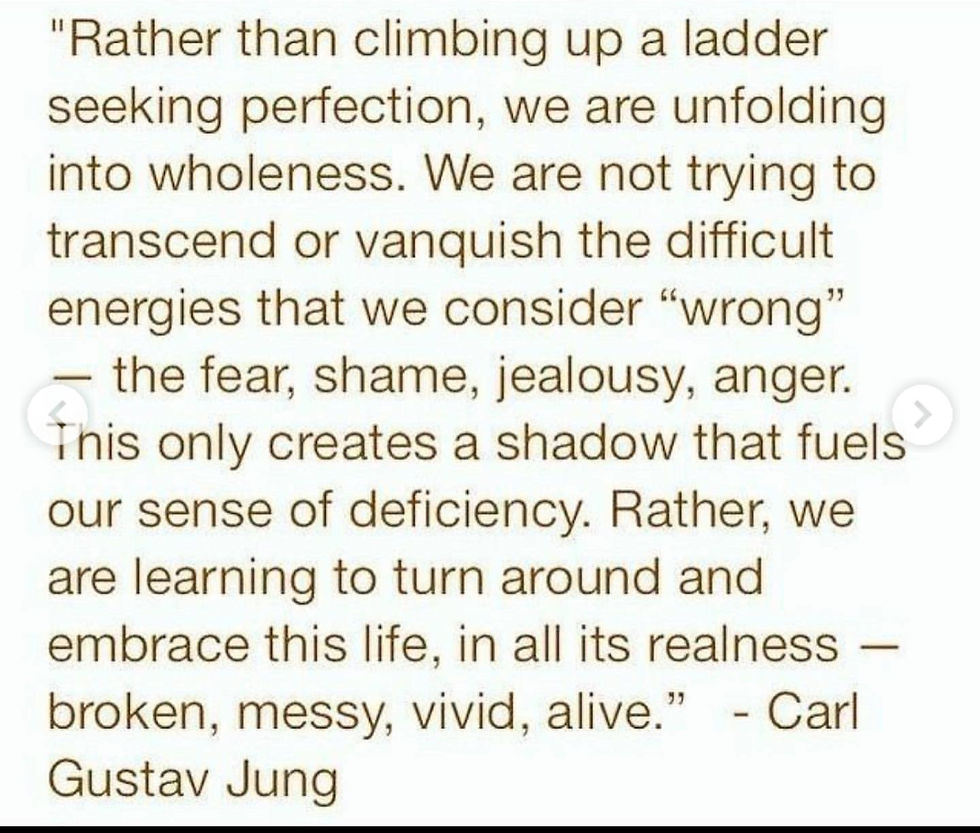

(Existential Kink, Pg 33)
Shadow Work:
Start with deep belly breathing or doing anything you like to soothe your nervous system.
Close your eyes.
Think back on your day, week, this month, or many years.
Do you notice any negative patterns? Was there anything that triggered you?
If this is new to you then start by observing your tomorrow and bringing more attention to your thought patterns or behaviors
You can play with the archetypes and which ones feel most relatable
Some find it easier to tune into their “shadow” by drawing their shadow or writing out qualities you think your shadow has
Maybe you have a persistent, ever present negative dialogue in your head. Write it out, get it out of your head and body and put it on the page. As you write, act as an observer to your thoughts and to yourself as to not block out certain information due to judgement of yourself
Further explorations:
Carolyn Myss Archetypes
Carolyn Elliot Existential Kink
“Our shadow side can drive the dark or negative repeating patterns in our life: always choosing the abusive partner or boss, settling for less, thinking that we’re undeserving, not worthy. But it also is the source of our greatest power.”
- Carolyn Elliot Existential Kink

History of the Shadow
Carl Jung is credited with the term “shadow work” but the concept of an inner shadow shadow/s however there is a long history of what could be called “shadow work” in other cultures, religions, traditions, histories that go by different names. Indigenous shamans from South America, mystics, and scholars have used “shadow work” in different names since their conception. Schools of different tantric gnosticism in Hinduism, Buddhism, and Western Esoteric ask their initiates to play with high sensation, highly “charged” emotions and transmute them into raw, unbound energy in their bodily systems. These traditions ask their members to take the taboo, intense feelings of pain and pleasure, and transform them into conscious energy.
There are also many religious figures like Morrigan (Celtic) or Shakti and Shiva (Hinduism) who embody the taboo, the light and dark, the terrifying yet powerful parts of human nature.
Even the Bible, has passages that relate to shadow work:
“Why do you observe the splinter in your brother’s eye and never notice the plank in your own? Take the log out of your own eye first, and then you will see clearly enough to take the splinter out of your brother or sister’s eye” (Matthew 7:4–5)
[While looking up shadow work and Christianity since I don’t know who’s who in class, I came upon this website cac.org where Father Richard speaks on Shadow Work in the Gospel. I keep this here because I do not where people’s faith lies and I want be inclusive for everyone. But also… I love the line at the end: “Wild beasts and angels reside in the same wilderness…” it is poetic and true and perfect for exploring your arts praxis.
“Jung asks: “How can I be substantial if I fail to cast a shadow?” [1] He makes clear that the unconscious is not bad or evil; it is just hidden from us. Jung describes shadow also as “the source of the highest good: not only dark, but also light; not only bestial, semi-human and demonic, but superhuman, spiritual” [2] and, in Jung’s word, “divine.” That is why we dare not avoid the deep self. Wild beasts and angels reside in the same wilderness, and it takes the Spirit to “drive” us there (see Mark 1:12–13).

Shara Hughes
Hang dog
Shadow in Society/ Collective Shadow:
There is both the personal, individual shadow and the collective shadow which intersect and merge with each other. The collective shadow consists of the repressed or denied aspects of humanity that are shared across cultures and societies. It embodies the undesirable traits and tendencies that people collectively reject or ignore. Jung believed the collective shadow could manifest in various ways like cultural norms or collective fears. Collective shadow is what society as a whole does not want to acknowledge or make efforts to resolve. Collective projections, aggressions, prejudice, or intolerance is an expression of the shadow. By acknowledging and integrating these shadow elements, both individuals and societies can achieve greater psychological balance and self-awareness.
Mask Making, Art, and the Shadow
“All great things must first wear terrifying and monstrous masks in order to inscribe themselves on the hearts of humanity.” - Joseph Campbell
Art can be about knowing yourself, being intimate with yourself and disregarding ideas of perfection or what something “should look like, should be”. Cultivating creative expression is about unblocking creative flow, taking risks, being intimate with yourself and therefore your art. Getting in touch with your shadow may help unlock a creative bliss, a well of creativity you did not know you had. Mask making can be an invitation to make the unconscious, to bring our shadow into the light.
A mask, which Jung called a persona, is "how one appears to oneself and the world, but not what one is". The etymology derives from per sonare, to "sound through", and refers to masks worn by ancient actors who had to project their voices to the audience through fitted mouth tubes. A mask reveals as much as it conceals, and it can grow into the wearer's face, imperceptibly merging with the "true", silent self.
A mask can either help with self expression or hinder it. It can serve as a protective force, an armor.
Questions for yourself:
Is there a role you slip on very easily? A mask you put on in certain situations or around certain people?
The mask of victim, child, prostitute, or saboteur?
Do you use a mask to shield painful feelings?
What do you want to protect?
Where are your vulnerabilities?
References for the Shadow:
Meeting the Shadow: The Hidden Power of the Dark Side of Human Nature by Connie Zweig, Jeremiah Abrams
Existential Kink Carolyn Elliot
Unknown Article from Tatiana Dellepiane
References For Masks and The Shadow:
https://learn.saylor.org/mod/book/view.php?id=61573&chapterid=50370#:~:text=Nietzsche%20 maintained%20that%20%22 every%20 profound,69).
Comments